

Tetris is an untouchable juggernaut of gaming. Of pop culture at large, even. It’s one of the few games, if not perhaps the only game, where the general populous agrees that it is design perfection. Even people who have zero interest in video games know what Tetris is, and enjoy it to boot. The Game Boy version alone has shipped more copies than there are people living in Australia. How can you possibly follow up that staggering level of success?
Hats. Hats are how.
…
Wait, what?

Hatris was one of the first handful of games Alexey Pajitnov designed after his newfound Tetris fame, alongside his friend Vladimir Pokhilko. However, there’s something we need to get out of the way before this post can continue. Thankfully, this situation is a massive outlier in the wacky world of the NES, but it’s also something I wanted to address. So, here’s an unexpected warning: there is talk of murder/suicide ahead. If you’re of a sensitive disposition, please feel free to tap out, and I’ll catch you in the next entry.
To continue on with that strange addendum – the aforementioned Vladimir Pokhilko was a real person who murdered his wife and young son before ending his own life in a prolific murder-suicide in 1998.
One might wonder how this real-life tragedy is inherently relevant to Hatris as a gameplay experience. I’ll tell you how: Vladimir is a character in Hatris.

He’s not just an NPC you talk to here and there, either. He’s a constant presence in the game, portrayed as a cute little fellow who is constantly on the right side of the screen while you play. He can even be frequently called on as a power-up, and yeah, it’s kind of uncomfortable knowing this man is the only instance in NES history where a game’s lead designer, as well as a character in the game itself, was involved in a real life murder-suicide. Knowing such dark information about that character put a damper on things.

I’ll not dwell on that though, so let’s move on. If one can manage to look past the tragedy surrounding its co-creator/co-character, Hatris is a game with cute graphics, good music, and a relaxed vibe. But in terms of game design, Hatris did not improve upon the perfection that was Tetris. Hell, Tetris might be the toughest act to follow in the history of video games, and it came nowhere near that impossible standard. But even if you don’t take any of its pedigree into account, Hatris just doesn’t have much oomph behind it.
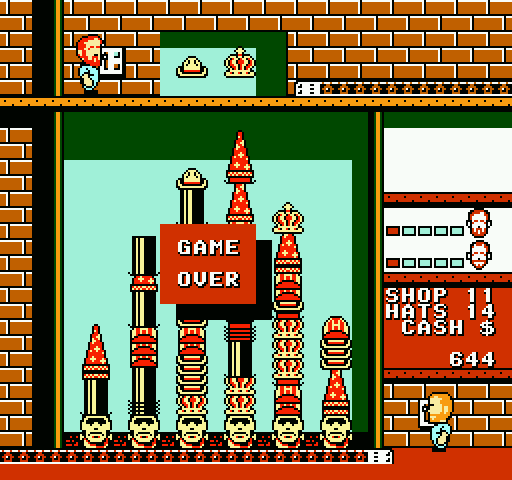
The basic gist of Hatris is that Alexy and Vladimir run a hat shop. Hats of various kinds fall from the top of the screen, and you have to stack them on top of hats of the same kind to “sell” them to customers. If you’ve ever played Yoshi for the NES/Game Boy, the two games share a lot of similarities. As previously touched on, both of the guys also serve as power-ups; Alexy discards five hats from the bottom of a pile, while Vladimir swaps stacks around. Vladimir is the much more common power-up, meaning he’s constantly relevant to your gameplay experience, for better or worse.
Much like the aforementioned Yoshi, there’s almost no depth or strategy to be found in Hatris. No combos, no quick manoeuvres, no strategy no nothing. It’s a puzzle game that’s entirely RNG based, and no amount of practice will elevate your game. Hardcore puzzle fans and casual gamers alike will be turned off by the lack of replayability here. In fact, that’s likely the reason Hatris never took off in the way Pajitnov envisioned.
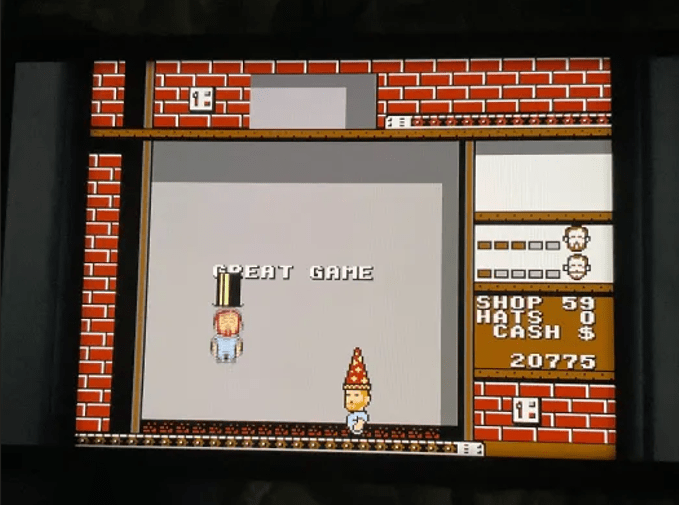
And so we come to the end of talking about Hatris, because there’s not much else to say. Strictly from a gameplay perspective, there can be some fun to be had if you don’t turn your nose up at its simple nature. But the total lack of depth and speed won’t have most folks coming back for a second helping. Searching “I love Hatris” on Google yields a whopping 4 results…one of which is someone openly saying the game is shit, but they enjoyed it regardless.
As for me? I dunno. I didn’t hate it. I even kinda liked it, just a bit. But I blame that on the cute graphics and music lulling me into a placid state of mind, helping to numb the lack of depth on display with bells and whistles. Like jingling a set of keys in front of a baby. In this instance, I am the baby.
Sorry, I’m losing the thread here. What I’m trying to say is that I’ll probably never play it again, and I’d 100% still feel that way – even without its history. Hats off to that, I guess?
Final Rating:

 NESJunk