


Wall Street Kid ・ザ・マネーゲーム2 兜町の奇跡
Developed by: SOFEL
Published by: SOFEL (NA, JP)
Released on: December 20th, 1989 (JP), June 1990 (NA)
During the 1980’s, America and Japan had one thing in common: excess. Big hair and big profit margins went hand-in-hand, and the brokers strutting around the booming New York stock exchange were seen as the ultimate image of glamour and success by many.

The Charlie Sheen/Michael Douglas film Wall Street (1987) was a hit despite 99% of the dialogue being incomprehensible stock market jargon that was likely sanitized by Hollywood to sound snappier than it actually is. Douglas’ Gordon Gekko character – a lying, cheating, stealing psychopath in suspenders – is still considered the definitive symbol of the hyper materialistic yuppie subculture to this day. All that lack of happiness in his life and selling everybody he’s ever known down the river for a nickel wasn’t important. What was important was that he was, like, super duper mega rich.
Another well-known (and family friendly) example of this archetype could be found in Michael J. Fox’s Family Ties character, Alex P. Keaton. He’s a slick-talking suspenders-clad teenager who dreams of growing up and thriving on Wall Street. His ambition is to become the Wall Street Kid, if you will, and you knew the guy was serious about it because of his suspenders.

When pop culture touches on that stereotype of the wannabe stock broker now, it’s with no shortage of abusing coke and speed, hyperactively blithering “SELL SELL SELL!” in a room teeming with like-minded madmen crashing and burning along with the economy. The modern equivalent would be some bot sliding into your Twitter DM’s to try and sell you a bogus cryptocurrency. Significantly less exciting and glamorous. We used to be a proper country.

Meanwhile in Japan, a similar ideal was being upheld. The 80’s Japanese bubble economy is a phenom that I won’t dissect too much here, as I’m sure plenty of people much more qualified than me have done so across the internet. But the long and short of it was that Japan entered an absurdly affluent period of economic growth back then, meaning cash was flowing like water for just about anyone who was willing to put the work in. It’s thanks to this phenom that the already mega popular Nintendo Famicom soared to astronomical levels of success. Even the worst titles on the system sold copies in the hundreds of thousands back then, simply because parents could afford to spoil the children they never saw with ease.
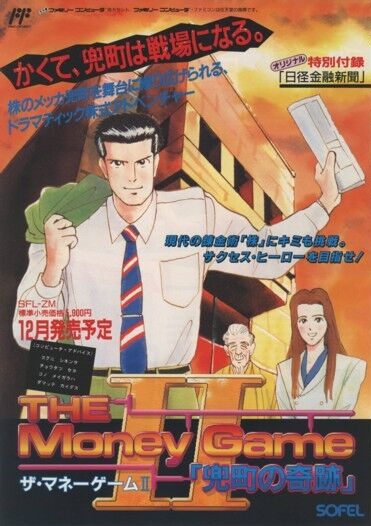
Amidst the “greed is good” mindset that was sweeping both nations, some weirdos made a Famicom game about playing the stock market: The Money Game (1988), which sold well enough to spawn The Money Game II: Miracle of Kabutocho (1989). Money Game II was then overhauled so significantly I’m not sure you could even call it the same game, and the resulting…whatever it was came to North America as Wall Street Kid in 1990.

The #1 most common talking point about Wall Street Kid is players wondering just who the hell this game was meant for. It goes without saying that most kids in 80’s America or Japan would not want to play a stock market simulator over the worst action games available at the time. Even if kids who genuinely aspired to be the next Alex P. Keaton existed in small numbers, developers Sofel surely couldn’t have been banking on any coolness appeal of those yuppie characters when the Wall Street boom and hyper-excess of the 80’s was fading fast by 1990.
So then, despite the “Kid” in the title, is it meant for adults? Some North American adults surely owned NES’s back in the day, and that number would soar if expanded to include adults who play their children’s NES’s on occasion. But I gotta say, it feels like bad business sense to try and corner such a hyper specific niche for something typically viewed as a kid’s thing when manufacturing NES games in bulk was a long and expensive process. Like, $100 Steam indie publishing fee, this was not. But I’m no economist or whatever. I just play the Nintendo games.

The Japanese Money Game II had plenty of screwball humour peppered throughout it. Protagonist Yusuke is tasked by his girlfriend’s father to make a fortune to win her hand in marriage. Finding the idea so impossible, the dude jumps into a time machine to take advantage of insider trading tips from the future (?!) to achieve his goal. They should’ve leaned into this full-throttle for the North American version, making the player character an amalgamation of both Marty McFly and Alex Keaton, but no such luck. Instead, you play as some nameless guy who looks like someone who would snootily call the kids of Riverdale “a pack of upstart twerps” before slipping on a banana peel in an 80’s era Archie comic strip. This is him:

As whoever this guy is, you’re tasked to turn $500,000 into a cool million by the end of the month via the stock market. You’re meant to use this seven figure sum, in 1980’s dollars mind you, to buy a “decent” first home for you and your sweetheart. If successful, this puts you on the path to inherit a staggering $600 billion dollars in assets from your recently deceased distant uncle Nofirstnamegiven Benedict. Adjusted for inflation, that’s $1,174,172,185,430. So in modern terms, unc has posthumously promised to make you the first trillionaire in human history.
But that rinky-dink million dollar house is only the first hurdle, as the game’s end goal is to buy back a European castle that was kept in the Benedict family since ye olden times until the uncle sold it. I’m not clear on why uncle Benedict felt the need to move to the USA when he had already inherited a goddamn castle in Europe. Maybe he had to go through this whole “stock market as a means to prove you’re worthy” song and dance with his then-recently deceased distant uncle, and that was a Wall Street Kid prequel game waiting to happen. Whatever the case, I like the angle about the time machine much more.

Let me pre-face the actual review part of this post by saying that I love dense simulation games, like Koei’s catalogue. Nobunaga’s Ambition and Gemfire are both some of my top favourite NES titles, so I’m one of the freaks who actually enjoys juggling a bunch of numbers and turning them into bigger numbers to beat the other guy’s numbers. In fact, I’ve always been super curious about Wall Street Kid, hoping that some of the manic energy of real life stock trading made it in here. After all, playing the stocks can be so complicated and dramatic that you’d think this game would be chock-full of wild endeavours to undertake. Do you risk it all by flirting with the danger of insider trading, or do you try and eke out as honest of a living as one possibly could in this field? Get coked up at lavish parties and wake up in someone else’s empty bed missing several hundred thousand dollars out of your bank account, or be a model husband and keep your nose to the grindstone to give your wife the comfortable life she deserves?
As astute readers may have been able to guess, there is none of the glitz, glam or debauchery of the 80’s ideal of Wall Street in Wall Street Kid. Wall Street Kid is a bare bones numbers game with pokey pacing, zero strategy, and little in the way of personality. Sigh.

Each in-game day begins with reading the newspaper. The newspaper has a “hot tips” section that explicitly namedrops five companies that are on the rise (for example, Yapple Computers). Dump all of your money into one stock that was named that day, and hang onto it until it stops being in the “hot tips” section. Sell what you’ve got, buy some new thing that’s named there, rinse and repeat until the game is done. I guarantee you can beat the game in an hour or two using this method; and that’s not some speedrun-y way to blast through it, either! I tried buying stock in multiple companies, as well as buying low/selling high independently of what the newspaper says, and none of it works. You will always come up significantly short of that first $1,000,000 hurdle, and the game ends. The only way forward is to do exactly what the newspaper tells you do, and to not deviate from it.
If you think that sounds dull, imagine playing it. I can’t help but feel like this game does a poor job of capturing anything exciting about the real life stock market by removing the element of risk entirely. But again, I’m no economist. I didn’t even pay for this game.

Inbetween whittling away the days by staring at your office clock, there is some extremely light life simulation you can indulge in. Like, “barely qualifies as a mechanic” light. You have a fiancée that you can take to one of three date spots (whoa!), and you can also exercise in one of three spots (holy shit!!). There’s no further interaction here, either; just pick a locale from a menu and the deed is done. Failing to do these things regularly will result in Lil’ Miss Fiancée calling you to say you’re being neglectful or getting fat, respectively. If you’re too neglectful or too fat the game ends, so you’d think it would be important to pay attention to this…but if you just do both once a week keeps your fiancée appeased, allowing you to continue frittering away your free time.
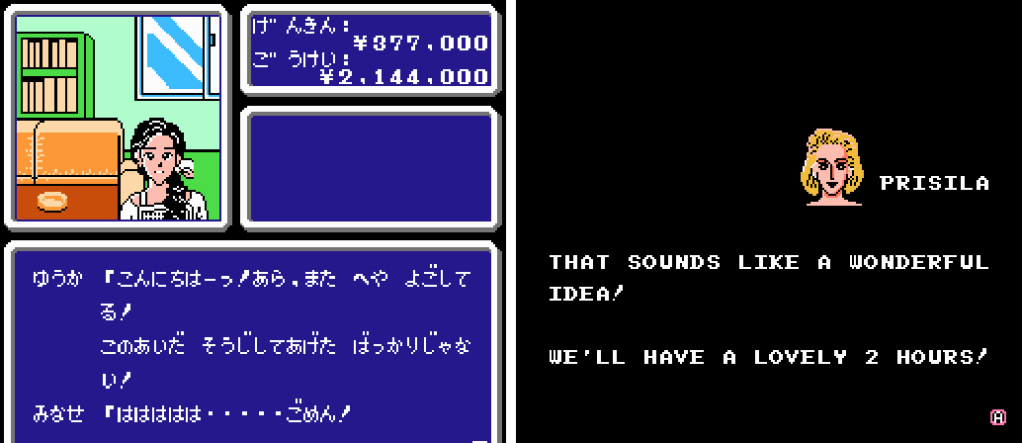
In the grand tradition of late 80’s simulation games, there is next to nothing in the way of graphics to stimulate you visually. What little is on display is aesthetically pleasing enough, though the total lack of variation pales in comparison to the original Money Game II. The compositions of the music are pretty good, but I found the soundfont used to be shrill and unpleasant. As you can see in the photo below, I played through the entirety of Wall Street Kid muted.
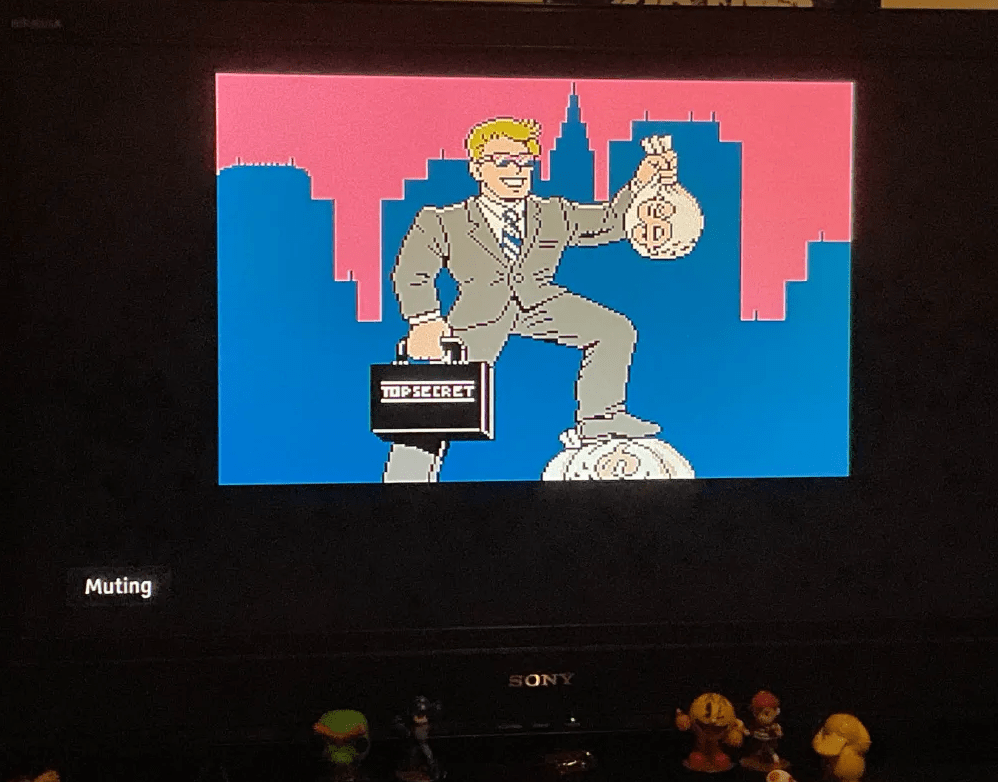
And uhh, I’m already out of things to say about Wall Street Kid. As a game, it’s little more than a mediocre sim game with no target audience, or vision, or fun, or mechanics, or surprises, or…anything, for that matter. With zero depth or strategy to keep players coming back for more, it’s barely worth one play through. Never mind more than that. I can respect the stab at trying something so out of left field, especially at a time when games were strictly considered kids stuff. It’s not really worth your time, but it’s not like it’s godawful either. Maybe some people like a lack of stimulation in their video games, but I can’t say that I do.
I have no idea how to end this post, so here’s what the Kid looks like when you get a game over:

Final Rating:

 NESJunk