


Barbie (1991)
Developed by: Imagineering
Published by: Hi Tech Expressions
Released date: December 1991 (NA) | 1992 (EU)
When the pastime of “ironically ingesting things purely for irony’s sake” was on the rise in the early 2010’s, a friend and I binge watched the then-new Barbie: Life in the Dreamhouse webseries; an unironically a funny show if you like a constant undercurrent of tongue-in-cheek satire and campiness with your children’s cartoons. I know I do. I bring this up because it’s the only personal connection to Barbie I’ve got. I was never big into dolls as a kid, so like many others who have taken her Nintendo game for a spin, I’ve got no nostalgia whatsoever for Ms. Barbara to enhance my enjoyment. On that note, let’s dive in!

Barbie on the NES opens on our glassy-eyed heroine thinking about the busy day she’s got lined up for tomorrow: having lunch at the soda shop, going swimming at the beach, and finally, closing out the busy day by meeting Ken at a lavish party. If there was a catfight thrown into the mix of that to-do list, it would easily resemble any given episode of a Real Housewives series. Sadly, there is no catfighting in Barbie. As a matter of fact, there isn’t any fighting at all. There are some cats, though.
The game begins when Barbie falls asleep. In a stand-out example of video game narrative seamlessly blending into the gameplay, every one of Barbie’s tasks for tomorrow is represented through a level of the game, with the dream quest starting off in a non-descript mall that she did not mention at the beginning. Hmm.
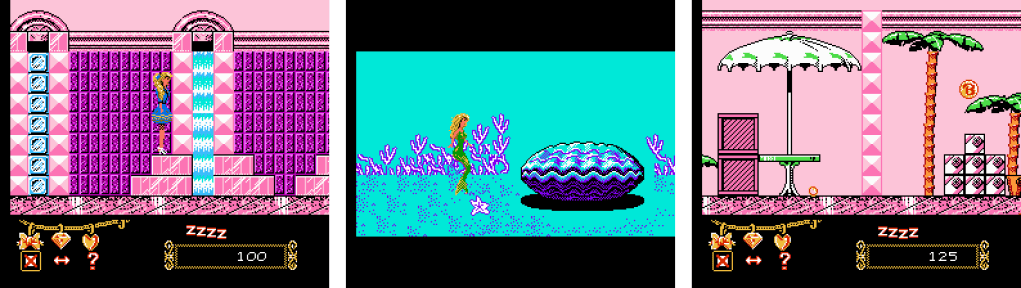
Barbie’s only power in this game is her magical charm bracelet. Even though Barbie had 67 respectable and interesting jobs as of 1991, she utilizes absolutely none of them (unless “mermaid” is a legally recognized occupation in the Barbie mythos). If there was ever a time for United States Army Officer Barbie to show off her CQC skills, would it not be HERE?!
Anyway, back to the bracelet. Barbie’s got three charms that affect characters and pieces of the world in different ways – using one of them on a friendly character will cause them to get rid of an enemy on-screen, or help her reach a different part of the stage. They can also be used to uncover useful hidden items that grant invincibility and such, and can even be thrown at different angles depending on how long you hold down the button. This brings a light puzzle solving element to the game, which adds a small layer of depth one wouldn’t expect from a Barbie title. The ol’ gal’s full of surprises!

In all honesty the game design isn’t too shabby, but the large size of Barbie’s sprite and the slow pace at which she moves brings the action down to almost nothing. Not to say that Barbie on the NES would have set the gaming world on fire if it moved faster – this was clearly designed with a younger audience in mind. But with that said, the player only gets a few lives and no continues to conquer the game, which artificially ratchets the difficulty of this leisurely paced kid’s platformer to be a little tough. Tough for a Barbie game, at least.

Barbie was developed by Imagineering, who were the creative (?) forces behind another licensed 1991 game I reviewed a few years back: Attack of the Killer Tomatoes. The two titles have a lot in common – namely having top-notch background visuals, mediocre sound design, and inoffensively bland gameplay. To quote myself from a few years back: “it’s not so good it’s good, so bad it’s good, or so bad it’s bad. More like so so-so it’s so-so.” Those Imagineering guys were really good at not leaving any impression whatsoever.
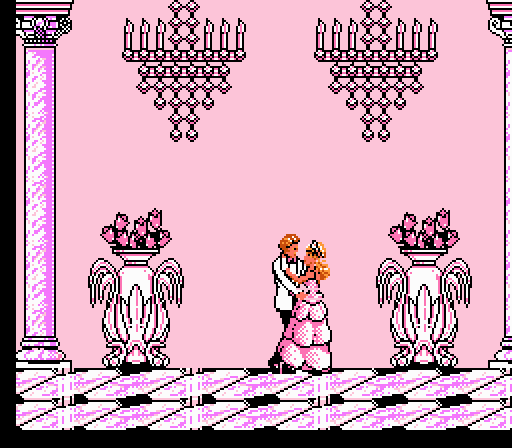
I can’t exactly give Barbie a glowing recommendation, but you may be pleasantly surprised to find it’s not the irredeemable hellspawn stuffed into an NES cartridge that many a 2000’s-era angry reviewer may have lead you to believe. Your time is likely better spent watching Barbie: Life in the Dreamhouse, though.
Final score:

 NESJunk