

Popeye • ポパイ
Developed by: Nintendo R&D 1
Published by: Nintendo
Released in: JP (1983), NA, EU (1986)
Popeye is an iconic characters that has steadily fallen out of the public consciousness, prevailing only through decades-old marketing. Similar to the Flintstones’ modern relevancy coming down to their multicoloured vitamins, the sailor from a bygone era is best known for his mug adorning boxes of chalky “candy sticks,” and bags of spinach. I never understood why those candy sticks were Popeye-branded “cigarettes” in the first place when he’s more of a pipe smoking gentleman, but who cares. All the same, he remains a character that’s recognizable to many a generation; the 1980’s being no exception.

While adults weren’t exactly the core clientele of video arcades, machines still cropped up in adult-oriented places quite often; including but not limited to bars, casinos and the like. When arcades started to wane in popularity in the late 90’s/early 2000’s, a small subset of the pre-existing gaming dens even became dual-purpose shops to recoup costs, sharing floor space with peep shows and other seedy avenues of adult entertainment. Not sure why you’d want to go for a round of Street Fighter before paying to stare at some chick’s arse, but different strokes for different folks, I suppose. My long-winded point is that that adults liked games, too, even back in the early 80’s. Remember that for later.
Nintendo was making shaky attempts to find their footing in the game industry at this point in time, releasing a sizable handful of games that were carbon copies of other, more popular arcade hits. Once they eventually found success with lovable chimp Donkey Kong in 1981, it was on the up and up for them on the gaming front, but where were they to go after their first hit? Popeye, of course!

The Big N wasn’t so big at this time, so they couldn’t lean on Mario or Link for easy successes just yet. A logical step toward further fortune was to borrow a pre-existing popular franchise (especially since that weird Robin Williams/Shelley Duval Popeye flick would have still been fresh in the minds of the public) and make a game about that instead. While the Nintendo of today wouldn’t touch someone else’s IP with a ten foot pole, the Nintendo of the 80’s was a little more willing to pick at the low hanging fruit of “licensed tie-in.” Remember what I said about 80’s adults liking games, too? Good! That comes into play right about now, as Popeye would be a recognizable name for people of all ages, making the cabinet a popular one, and another success for Nintendo.
Popeye is the only Nintendo made game that wasn’t about one of their original characters… besides their other Popeye game, Popeye no Eigo Asobi; a 1983 effort to teach Japanese children English words, which incidentally was just a re-skin of their Famicom port of the arcade version.
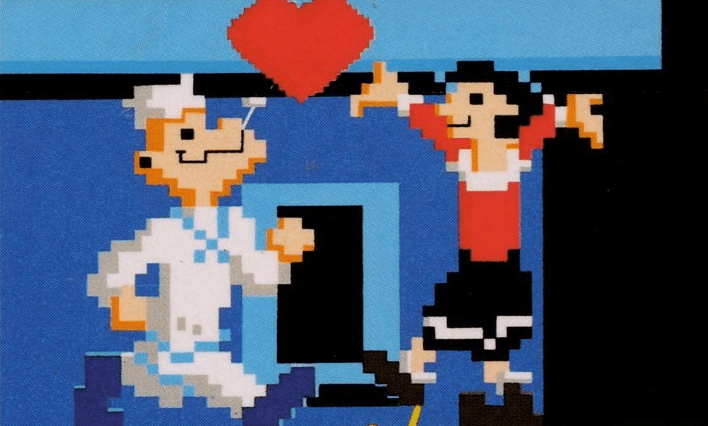
Speaking of the home port, let’s talk about that. Popeye was one of the illustrious three games available for the Famicom on launch back in ’83. As such, it sold over 400,000 copies in Japan alone, and would go on to sell 500,000+ more as an NES “black box” launch title in 1986 as well. And you can take those figures to the bank, sailor. Uh-gug-gug-gug!
Popeye follows a formula extremely similar to Donkey Kong, which makes sense; the first DK game was originally meant to be a Popeye game, but at that time Nintendo couldn’t obtain the license to use the characters, so they had to come up with their own. Crazy how that lack of a business transaction birthed Donkey Kong and Mario; who knows how long it would have taken for them to have their debut if that original Popeye title had come out? There’s an alternate universe out there where Popeye is the most recognizable game character of all time, while that weird little “Jumpman” guy fell into the annals of obscurity. What a world that would be.
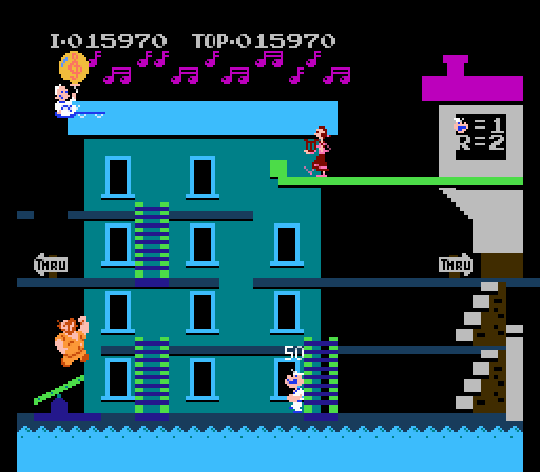
Anyway. Popeye. To simplify it, the game feels like a Donkey Kong sequel, with the titular sailor man running up and down stairs instead of ladders, and the big lug of an enemy wandering about the stage instead of being stationary, looking to kick your head up your own ass if he gets a hold of you. Popeye can’t jump or do much of anything besides run and punch weakly until he gets a hold of a can of spinach; then he can punch extra hard, knocking Brutus on his ass. Or is his name Bluto? The big guy, I don’t know. Whatever. Point is, in this game, spinach = the super-dee-duper hammer Mario uses to smash barrels in Donkey Kong.
The game’s objective is also a simple one; Olive Oyl is at the top of the screen (similar to, once again, Pauline in DK) and she throws a bunch of crap off of the roof tops for you to catch. Hearts, musical notes, and the letters H, E, L and P, which is probably supposed to spell something. The thing in question flutters to the bottom of the screen like a beautiful cherry blossom, but if you leave it at the bottom for more than a few seconds, you die. Once you catch a fair amount of whatever the hell, you move onto the next level. This game’s loop point is only on the third level, so I “beat” it in a few minutes at best. It takes longer to finish a box of those candy cigarettes than it does to finish this game.

I know that the point of such arcade games is to get the highest score possible, but I didn’t feel like doing that with Popeye. It just wasn’t a game I felt inclined to play for a long period of time. While it was fine enough, it’s certainly no Donkey Kong. I felt like I had seen everything the game had to offer in the span of five minutes, and that’s okay by me. Quick and easy is my favourite kind.
I don’t hate Popeye by any stretch of the imagination; I’d go so far as to call it fun, but it didn’t rock my world, either. It’s definitely worth a look from a historical standpoint, and you can’t go wrong with something that’s so short if you’re only aiming for the clear. Just don’t let some slimy game reseller trick you into thinking it’s some rare must-have cart if you’re looking for a physical copy, and you’ll be as happy as a pig in slop. Or a Popeye eating spinach, as it were.
Initial Interest Rating: 8/10
Final Rating:

 NESJunk